For a long time I was confused about the difference between salves, ointments and balms. Some writers use all three terms interchangeably whilst others have separate definitions, many of which contradict those from other sources. In this post I wanted to tell you a little about how I make salves, ointments and balms with the intention of sharing some hopefully useful tips and practical information.

Salves, ointments, unguents, balms, call them what you will, what all these preparations have in common is they are primarily a semi-solid mix of fatty ingredients such as oils and waxes, usually with no water part at all, though they may contain a small amount of herbal tincture or similar. This differentiates them from creams and lotions which contain both fats and waters.
Generally, ointments and salves are considered much the same thing; a healing external preparation made with medicinal substances in a base of oils and waxes. According to the Miller-Keane Encyclopedia and Dictionary of Medicine, Nursing, and Allied Health an ointment is “a semisolid preparation for external application to the skin or mucous membranes. Official ointments consist of medicinal substances incorporated in suitable vehicles (bases). Called also salve and unguent.” All in all the definitions are pretty vague which is probably why we find discrepancies.
Suitable ingredients for a salve include many vegetable oils (such as olive, sunflower, sweet almond, apricot) and beeswax or vegetable wax such as candelilla or carnuba. In older herbals lard or animal fats were often used and these are enjoying something of a comeback amongst some traditional herbalists but, as a vegetarian, they don’t feature on my radar so I won’t be talking about them here. Many herbal books include recipes made with mineral oil byproducts such as petroleum jelly or vaseline but again, as I don’t work with them, I will not be including any information here.

As making salves involves some degree of heat it’s best to use oils that are fairly heat stable, the main ones to avoid are oils like flax seed, evening primrose and borage. If you want to include these then stir them in after the other ingredients have been melted and are beginning to cool. Coconut oil is the most heat stable vegetable oil but as you will not be heating it very high, oils like olive, sunflower and apricot kernal can be happily used.
Beeswax comes in two varieties, white and yellow but the white is bleached and processed so I never use it, it’s always better to stay as close to nature as possible. Candelilla wax is derived from the leaves of a shrub native to Mexico and is slightly harder than beeswax so you generally want to use a fraction less in a recipe. Carnuba is a similar product derived from a Brazilian Palm. The advantages of these two is that they are vegan so products can be made that are suitable for everyone. The disadvantage is that they come from a very long way away (at least if you live here in Europe!). It’s a tricky choice as some producers of bee products are far from ethical or kind to their bees. I do use beeswax but always try to get it from a local supplier that I know I can trust.
Basic Salve Recipe:
90ml herbal infused oil
10g beeswax
Basic Vegan Salve Recipe:
92 ml infused oil
8g candelilla wax
Medicinal Salve Recipe:
75 – 80ml infused oil
10g beeswax
10ml tincture
2 – 5 ml essential oil
Method:
Weigh or measure out the wax (preferably grated or cut into small pieces) and the herbal infused oil and place in a double boiler or bain marie. Heat over a low heat until the wax is fully melted and then stir well. If adding tincture drizzle it in slowly now whilst whisking lightly with a fork. Remove from the heat and allow to cool slightly but not set. You can test the consistency of the salve by dipping the tip of a teaspoon into it. Such a small amount will set quickly and will show you how the finished product will be. If you are not happy you can return it to the heat and add a fraction more oil/wax until you get it just right. Whilst the salve is still liquid, stir in the essential oils, pour into glass jars and cap immediately to stop the volatile oils from evaporating. Allow to cool and set completely before using.
You can make salves for use as chest rubs, for treating aches and pains, for protecting and healing dry and sore skin and many other uses. The recipe can be easily adapted according to your preferences or required ingredients. A very simple skin healing salve can be made with calendula infused oil and beeswax or a chest salve with olive oil, wax and 5% suitable essential oils. The possibilities are limitless!
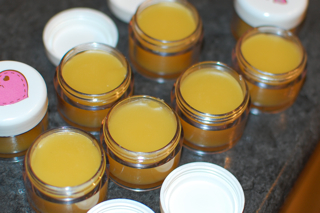
Balms are similar to salves, some people class them as the same thing entirely whilst others make a slight differentiation. According to James Green who wrote The Herbal Medicine Makers Handbook, “a balm is simply a salve that contains a relatively high amount of volatile oils. Upon application is delivers a notably intense cloud of aromatic vapours.” My understanding of a balm is that it is a salve that also contains butters such as cacao or shea butter making for a creamier end product. These are just individual definitions though so you can use whichever you prefer.
Cacao is fairly hard at room temperature so makes for a slightly firmer end product where as shea is very creamy and therefore a lovely addition to lip balms or body butters. Mango butter is also delicious and has a lower melt point and a more slippery consistency.
 Basic Balm Recipe:
67 ml infused oil
25 g cacao butter
5 g beeswax
2 ml vitamin E
1 ml essential oils of choice
Basic Body Butter Recipe:
57 ml infused oil
20 g shea butter
20 g cacao butter
2 ml vitamin E
1 ml essential oils
These balms can be made as above by melting the oils, butters and wax in a bain marie then adding the essential oils and vitamin E at the last moment so they will not be affected by the heat.

I hope that was helpful rather than just confusing the issue further! Happy making.
 Whispering Earth
As always full of useful information and beautifully illustrated. I love the way you present your products.
For me, that fact that you care about the health and treatment of the bees is a wonderful addition to this post.
I was a vegetarian for around 26 years. I do not eat meat but have introduced some fish into my diet. It does not rest easy on my shoulders but for some reason I felt the need. I tend to go with my feelings……
LikeLike
Thank you Cheryl, some day soon I hope to have my own bees to completely ensure they are well looked after, such marvellous creatures we must care for them the very best we can, just as you do with your wonderful gardens.
Consuming with great care and consciousness is the best we can do I think, whether we are eating animals, plants or anything else. So hard in this modern world I know.
Take care xxx
LikeLike
Hi there, I’ve been enjoying your blog for a while now. Thank you for this post! I would love to know more about how you make face creams as well. For the balms/ointments/salves, I was wondering, what are your favorite herbal components?
LikeLiked by 1 person
Hi Ffalstaf,
My favourite ingredients would depend on what the salve was for, would it be helpful if I did another post with some more specific recipes such as a chest salve, an all-purpose healing slave, a salve for aches and pains, that sort of thing? Let me know what you are interested in and I’ll try and be more specific!
Generally simple calendula, comfrey, chamomile and elder leaf infused oils make nice salves, either singly or in combinations. Spicy oils like ginger and cayenne can be nice for achy joints and warming, aromatic herbs like thyme are nice for chest salves with some essential oils too.
I will get round to doing a creams post soon, I love making (and using) nice herbal creams so have got a couple of good recipes now.
Thanks for stopping by and commenting.
LikeLike
Snap……when my grand-children are a little older I hope to keep bees. It is something I have always wanted to do. On Sunday I visited gardens in a local village. They had opened their gardens to make some money for the church restoration project. The gardens were beautiful but I came away feeling let down and I could not understand why. It was only during the evening I realised I had not seen one bee, one butterfly or any other type of bug…..it made me feel quite sad.
LikeLike
That is why your garden is such a magical place Cheryl! A haven for all creatures great and small. xxx
LikeLike
Thank you for tackling such a confusing issue! I think we also need an article on poultices, compresses and the like too since every book says something different there as well 🙂 I find myself coming more and more often to Whispering Earth to find instructions on how to make things – as you break things down in such an easy to follow way, and all your recipes always turn out fabulous 🙂 I’ve been inspired to make more oils by reading some of your posts, and now I shall be inspired also to make them into salves and balms 🙂
Hope your rain went away and you have lots of sunshine on our longest day of the year! Happy happy solstice to you, Mark and the kitties 🙂
Love,
D
LikeLike
I’m so glad you find something helpful here, thanks for your lovely words. I’ll definitely do a poultice and compresses post, I really enjoy them, though they can be a bit messy and fiddly. I get a rash on my legs sometimes if I eat wheat and a poultice is the absolute best thing for it, much better than salves or even creams.
May Solstice magic be with all of you too. xxxxx
LikeLike
Really, really, really good article that’s simply explains the confusion. Thanks also for putting up a vegan recipe too.
LikeLike
Thanks Martin. I’m glad it was of some help.
LikeLike
I would love to know more about salves for achy muscles and joints. I broke my ankle about a year ago and since then it’s always stiff. I made a salve out of poplar leaves (no buds available at this time of year of course) and that does help, but I like the sound of spicy salves!
LikeLike
I will post a recipe soon!
There are some tips in our April blog party on treating aches and pains too, this was my post –
https://whisperingearth.wordpress.com/2010/04/19/herbal-tips-for-aches-and-pains-april-blogparty/
Take care xx
LikeLike
Knitbone, my dear. crush or whizz fresh comfrey leaves, place between a piece of gauze and a plastic outside layer and place on the area that is healing. Comfrey heals bone. It also makes skin regenerate so quickly that it’s best to make sure all infection is gone before using it, or the new skin can seal in infection.
For achy muscles and joints steep fresh comfrey leaves in olive oil, or sunflower oil (natural phytoestrogens, aid healing) which is thicker. Cover completely and put in a dark place for 2 weeks, then strain. Make sure the leaves are compressed and covered, or mould will grow on the top.
Comfrey doesn’t smell nice, so rosemary steeped in with the comfrey is good- the rosemary is antibactierial and, like garlic, anti-inflammatory.
LikeLike
What an interesting post Lucinda,so full of useful information,so we can learn something.
Thanks for sharing Lucinda
Have a nice weekend – Rita 🙂
LikeLike
Thanks Rita, take care and have a lovely weekend too xx
LikeLike
I like so much to read your blog and to discover your cat’s mindfulness…
These few words (in my weak english) to tell you that I have put a link towards this article because I wrote about it recently on my blog.
(here :http://princesseaupetitpois.over-blog.com/article-baume-au-neroli-et-a-la-teinture-de-jasmin-80580340.html )
Many thanks
LikeLike
Thank you Venezia for your lovely comment and link. Your English is very good, much better than my French I’m sorry to say!
LikeLike
Hi Lucinda
I ordered some shea butter to make your body butter recipe but when i received it , it was soft and grainy. (organic unrefined) would it affect the outcome of the recipe. Any tips working with grainy shea would be much appreciated.
Kind regards
Rohini
LikeLike
Hi Rohini, if it feels grainy but melts when you rub a small amount into the skin or put it in a bain marie then it will be fine. I have had some in the past that seems quite crumbly but it still melts down the same. If the grains are harder and don’t melt you might want to consider checking with the supplier as it shouldn’t really be like that.
Take care. x
LikeLike
HI Lucida, thanks for the great post! What do you think about using soy wax for your recipes?
LikeLike
Hi Taylour,
I must admit I haven’t tried any recipes with soy wax so can’t be of much help to you. If I get chance to have a play with it then I’ll post an update.
Thanks for stopping by, I’m glad you enjoyed the post.
LikeLike
Thanks for “liking” my post. I have had the WildIndigo blog for some time but now trying to take it seriously and push forward with visibility.
LikeLike
Then I will add you to my blogroll. Thanks for stopping by.
LikeLike
I feel like a child in a lolly store…this is soooooo exciting, I am so pleased I have come across you and your precious knowledge of using mother earth’s treasures..thank you so much
Love and Light
Deb
LikeLike
Thank you Debbie! Your comment was lovely to read and I’m so glad you enjoyed the post. x
LikeLike
Thank you so much for the info. After watching 2 seasons of Backyard Medicine by James Wong. I am still utterly confused.Now, with your explanation, I am enlightened.
LikeLike
Hi Cyril, that’s great, I am so glad it was helpful to you.
LikeLike
You’re not only helpful to me but to everyone. Thank you again.
LikeLike
thank you so much for the wonderful info .. i have been making salves for a number of years now but find myself unable to get my hands on any of the needed ingredients i do have a large supply of essential oils and dried herbs. but am unable to procure anything like beeswax or any of the base oils i would normally use. what i do have is a LARGE supply of a basic unscented skin cream that is more of a paste at room temps. what i was wondering is if this would work in lieu of the beeswax and base oils i normally use . sadly my education in these matters is fairly narrow owing to the fact that the women who taught me refused to allow the use of any non natural product
LikeLike
Hi Josh,
It depends what you want to do with it really. You could certainly use the crem to mix in essential oils and small amounts of herbal tincture in order to make a medicinal cream but you wouldn’t be able to add large amounts of tincture or infused oil without it becoming too runny.
Many places will sell good quality base oils if you want to use the died herbs to infuse your own oils. You can happily use good quality organic carrier oils from the supermarket like sunflower or olive.
Let me know if you have a more specific question and I will try to answer it as best I can.
Hope it goes well!
LikeLike
what can I say, I came across this site while questioning the same issues and there it was….THANK YOU SO MUCH!!!! KEEP UP THE WONDERFUL WORK,
LikeLike
I want to make cuticle cream like burts bees lemon cuticle cream. would i use the balm recipe and just put lemon essential oil in it?
LikeLike
Yes that would work perfectly. You may want to slightly increase the beeswax to make it firmer if you live in a warm climate though, depending on how firm you would like the result to be. i haven’t tried the Burt’s Bees one to compare but this is a nice, fairly soft consistency.
LikeLike
i just love your blog so much wonderful information but i do have a question i have been using sweet almond oil in my salves but they dont seem to soak into the skin in the way i wish they would i have been doing some research and come across jojoba oil and it sounds like it might work a bit better than almond oil i was hopping i might be able borrow some of your insight thank you so much
josh
LikeLike
Hi Josh,
Jojoba is a lovely oil that is actually a wax, even though we use it just the same as an oil. It is said to be the closest to skin’s natural sebum and therefore well absorbed. It would be great to use in salves. Salves generally hang around longer than a cream and leave more of a protective coating but they should still be absorbed fairly well. I say try the jojoba and see if it makes a difference, And do let me know as it would be interesting to hear what you discover!
LikeLike
Greeting from Atlanta GA Lucinda!
I am VERY excited to find you, I am a urban Gardener of heirloom herbs and have been using them mostly for cooking and scrubs and have been yearning to venture into salves and balms. I recently lost my dear cousin (She was more like a sister) that was in the middle of her residency as an osteopath. I feel like she has been guiding me to make a balm/ointment/salve to honor her. The power of touch is powerful. I believe it heals the spirit.
May your spirit ever be restored by your good works! 🙂
Signed,
Neffie- The Sexy Seed Saver
LikeLike
Hi Neffie,
From the Sexy Seed Saver to the Sexy Salve Maker! Do let me know how your salve turns out, it sounds like it will be magical and a beautiful way to honour the memory of your dear cousin and friend.
I agree with you on the power of touch.
Many blessings to you.
LikeLike
Hi,
Made body butter as per your recipe .It was a simple and easy process, but I think it is too oily .( I used almond oil )Is it possible to reduced the oiliness .What if I substitute almond oil with some other oil ? Can you suggest a substitute?
Anu
LikeLike
Hi Anu,
Experimenting is really the only way to find a recipe you are happy with as everyone’s skin is different. You could increase the shea and decrease the cacao as shea butter is more creamy and less greasy. You could try replacing the cacao with coconut butter which feels oily on first contact but is absorbed very easily. Or you could swap the almond for a lighter oil like hazelnut or grapeseed or jojoba which is well absorbed by the skin.
Or you could add a small amount of a liquid (up to 10%), being sure to blend very thoroughly so it does not separate, which will lighten the overall effect.
Happy experimenting.
LikeLike
Lucinda and the whispering team hi and Happy 2013! I use your site almost weekly and dream of crunching through the snow this time of year in the North downs of Kent and south downs of Sussex! Our arnica finally gave us about 40 flowers this year and i would like to make a balm for my Nans arthritis. She is 85 and hunched over from coming up to 8 decades of gardening so i would love to heal her pain anyway possible. The problem is i cannot find beeswax here in Brasil. I have coconut oil, base oils, glycerina and a garden of medicinal herbs……could you please offer any help?
LikeLike
Hi Tracy,
There are lots of herbs you can try, the arnica would be good with some comfrey infused oil or try a warming blend of ginger, cayenne and turmeric which will help with the inflammation and pain. There was a post on making cayenne salve on learning herbs recently, here is the link:
http://www.learningherbs.com/news_issue_92.html
Instead of beeswax you could use cocoa butter if you can get it, though you’d have to use a higher proportion than the beeswax for it to set. The coconut probably wouldn’t be enough to keep the salve solid as you live in a warm climate but what you could do is infuse your herbs directly into the coconut oil and just use that. Or you could just infuse into a liquid oil and give it to her as a massage oil rather than a salve.
Let me know if you need any more advice. 🙂
LikeLike
Lucinda’s article is very useful and timely for me. . . I would like to make a salve for my husband who happens to have some itchy skin disturbance. . . i find acapulco useful. so, i applied on his skin that gets better. but i am applying fresh sap. so i want to make salve so that he can bring it along wherever he goes…
LikeLike
Hi Luzv,
Unfortunately we don’t have acapulco growing here so I have never used it. Could you collect a small amount of the sap and blend it into a salve? 10% or less will blend nicely. If you want to use a higher volume of sap then you will need to make a cream using one of the other recipes to help it emulsify.
LikeLike
HI! I am trying a recipe for a handmade natural tattoo ointment! Your guidance is very appreciated. Are there any recommendations? I purchased beeswax and shea butter for my base, to add vit. E oil, “Germ Fighter Synergy” essential oil and a bit of comfrey extract. I know I will need to keep my area sterile, any other advise? Thanks!
Mike K.
LikeLike
I like calendula infused oil for a tattoo salve. What oils are in ‘germ fighter’? I quite like just plain lavender essential oil as it is gentle and healing but also potent enough to kill bacteria. The Vit E is a good idea too. Just make sure you don’t use the comfrey on open wounds. Otherwise sounds great. 🙂
LikeLike
The germ fighter has Lemon, Clove, Eucalyptus, Cinnamon and Rosemary. So I shouldn’t use any comfrey for a tattoo salve?
LikeLike
Hi Michael, Comfrey would be fine once the skin has healed enough that it is not actually bleeding. They say a good tattoo artist won’t draw blood but in my experience they usually do! This is because comfrey can cause the skin to heal over very quickly, thus sealing in infection. If you are using anti-microbial oils that is unlikely to happen so it should be fine but it’s just something to be aware of really.
The ‘germ fighter’ sounds like a strong blend of oils! I would be tempted to stick to lavender myself but I am always drawn to gentler oils, especially where healing is required as well as the anti-microbial effect. Was this recommended to you by someone? If you use it just be sure not to make it too strong a blend!
LikeLike
Hello to all of you. This is my first attempt at making a topically applied healing ointment of sorts to aid in healing. I looked up this site by searching for mixtures and emulsifying agents. Is anyone available to help guide my search?
LikeLike
dear lucinda sorry i have not been on in a long time life gets in the way .. the jojoba oil worked wonderfully for salves became a beautiful salve of rose, chickweed, and lavender but i once again find myself asking advice of someone wiser than i. my partner and i where in an car accident a few months after my last post and i find myself with some lingering after effects. spasms in my neck and shoulders that leave me sitting in a corner crying for a parent that passed away years ago. my doctor has given me a prescription for muscle relaxants but i avoid taking them if at all possible. i hope to make a salve or liniment using clove or cayenne tincture something to help the muscles relax but i am unsure of how to even begin i am hoping to make some thing that will soak in a take effect quickly any help would be greatly appreciated
LikeLike
Hi Josh, I am so sorry to hear of your accident and I am sending healing thoughts to you and your wife.
A warming salve with cayenne, ginger and mustard would certainly be a good place to start. Also alternating rubs of cayenne and lobelia tinctures is very helpful for muscle spasm but check with a local herbalist first if you are on any medication from your doctor. You can mix some cayenne tincture into a little oil, add the tincture until you find it warming but not uncomfortable, shake well and then rub over the muscles. Then do the same with lobelia and back to cayenne again.
You can make a warming salve by infusing oils with powdered cayenne, ginger and mustard, then straining the powders out through a fine mesh and adding beeswax.
It might be worth looking at some internal medicine too, again I would check with a local practitioner who can tae a full case study but I would look into herbs like cramp bark or black haw, low doses of lobelia and something anti-inflammatory like ginger.
There are a few tips for aches and pains here: https://whisperingearth.co.uk/2010/04/19/herbal-tips-for-aches-and-pains-april-blogparty/
Very best healing wishes.
LikeLike
Hi Lucinda,
I have only just discovered your page and i love it! there is so much great info.
I was wondering how long you would expect the balms and salves to last? It is fantastic that they contain no preservatives, but considering this is there anything that I would need to keep in mind to prevent it from going rancid?
Thanks so much for your herbal Wisdom!
LikeLike
I’m sorry for the delayed reply to your question! I usually say that balms and salves will last a year as they have no water content in them so will not go mouldy but I have also known them to last quite a bit longer. The fresher the oils you use the longer it will take for them to go rancid. Antioxidants like vitamin E will help them last longer as will low percentages of essential oil. 🙂
LikeLike
Thank you for your kindness in sharing the useful info and your concern for God’s creatures! blessings, Laura R.
LikeLike
Thanks Laura. 🙂
LikeLike
Hi Lucinda,
thank you for really great post and blog. I’m a bit confused about adding alcohol tincture to salve. Wouldn’t it shorten the shelf life and speed the bacterial growth? I read some post saying that, since alcohol has some percentage of water in it. On the other hand I read some people add alcohol to cremes and lotions as preservative. Hmm…
I am asking that, because I’m selling salves. I want to add 10% tincture to horse chestnut salve, since aescin is only soluble in alcohol. However I think it would work just great if I made a salve with tincture for myself and use it in few weeks.
Mateja
LikeLike
Hi Mateja,
It would depend really on the percentage of alcohol that your tincture had but generally it shouldn’t shorten the shelf life too dramatically if it is well mixed into the salve. If you are worried then stick to a higher percentage tincture such as 45% or above.
All the best,
Lucinda
LikeLike
I would love to know if you could recommend a salve or balm that would help with chemo pain and discomfort. I am going through quite a bit and have lots of nausea as well as pain and just general anxiety. I know it sounds like a lot and I only have essential oils plus other things you would make these out of like oils or beeswax, shea butter, mango butter, almost every butter and vitamin e. Would really appreciate any help you could give me. As I have no herbalist in the area just my oils which I love. ♥
Thanks so much, I never knew one blog could have so much info. Absolutely amazing. 🙂
LikeLike
Hi Wendy,
I am not an aromatherapist, though I do use essential oils, so I might be of limited help to you. Also I think it is best to recommend things based on the individual case. However oils I would definitely consider would include lavender for general healing, pain relief, calming and anti-anxiety, rose for anti-inflammatory effects, uplifting qualities and anti-anxiety, chamomile for calming, soothing, anti-inflammatory, anti-nausea and healing, cardamom, anti-nausea and uplifting and frankincense which can help heal the skin.
There are also oils that can help stimulate the immune system but I would need to know your case to advise on this really.
I hope that is a little bit helpful and sorry I can’t be more specific. Wishing you very best healing wishes.
Lucinda x
LikeLike
Hi Lucinda
thanks for this comprehensive post- very useful. I made the salve, balm and butter today. I had a question about the butter- the instructions say to heat and melt the oils and the butters together, however Ive used other butter recipes where it calls to blend/ whip the butters and oils together (no heat required)- what is the difference of this technique? Is the end result still the same?
Incidentally my butter is still completely runny, however I might just be being impatient as I only made it 2 hours ago!!
With thanks, Misty
LikeLike
HI again,
Following on from my original post, my butter never set (left for 18 hours in cool-ish room) – it got slightly less liquid but definitely not what’d call a butter. I thought to whisk it and after a couple of minutes it was a lovely buttery consistency. What did I d wrong?
Thanks, Misty
LikeLike
Hi Misty,
Can you tell me exactly what you put in your butter with quantities? It will help me work out what might have happened.
Whipped body butter is slightly different, I have been meaning to post a recipe for it for a while so I’ll try to get round to it soon. Usually you would still need to melt the butter if you are using something quite solid like cocoa butter though. Whipping the butter achieves a nice light, creamy texture rather than the richer texture of this recipe.
LikeLike
Dear Lucinda,
I was so happy that I found your excellent blog and website about making herb things. I have been making salves, teas, and other herb things since my childhood, as I have a deep interest in nature and herbs (my profession is nature conservation engineering….). However I found your recipes so good and potent.
As making salves wasn’t a new thing for me and I was successful with your recipes, I began to think could I sell the salves somehow? Would it work?
So I would like to ask you that whether you know any legislation or law about this theme? Are there any regulation about selling salves and other herby things?
Other question is how much for could I send them? I mean I counted and got that one 30 ml pot of comfrey salve cost me only 0.55 pounds but if I look for a similar item on ebay, it costs 6-10 pounds. So I don’t know what should be the prices. Can you suggest something for me, please?
Thank you,
Linda
LikeLike
Hi Linda,
Sorry for the delayed reply. Are you in the UK? If so there is a course you can do around legislation for selling creams, salves etc held by Aromantic in London. It could be worth looking into. Here is the link to their list of courses: http://www.aromantic.co.uk/courses-making-natural-skin-care-cosmetic-products-uk.htm
I only make things for patients myself, not to sell to the wider public but do remember when pricing to include the cost of jars, labels and your time as well as well as the salve ingredients themselves.
Good luck!
LikeLike
When you say “drizzle” the tincture, I assume you’re not referring to an alcohol tincture..? Maybe glycerin?
I’m just curious if an alcohol tincture can be added to a salve..?
LikeLike
Hi Justin,
Yes alcoholic tinctures can be added to salves in relatively low quantities, up to about 10%. Glycerine should work too though I haven’t actually used it myself in salves.
LikeLike
Great, thanks!
LikeLike
thank you for this, very informative and thanks for including several recipes. 🙂
LikeLike
My family specializes in locating /harvesting/brokering of medicinal plants and herbs/roots. I would be greatly interested in finding partners or independent brokers who would be interested in wholesale production of a broad scope of Missouri finest medicinal roots and herbs into ready to use products for the everyday consumer. I am enthusiastic about learning anything and everything I can to try and take my yearly harvests and learning how to process them myself and to be able to open new doors for marketing and potential employment in my community
LikeLike
How many pots do you get with the basic balm recipe?
LikeLike
The basic balm recipe will make 100ml so it will depend on the size of your pots. I usually make about 600ml (so 6 x this recipe) which gives me 10 x 60ml pots.
LikeLike
Hello. I am very allergic to nuts, is there a substitute that I can use to get the same results for Shea butter. Thank you
LikeLike
Hi there, In this instance I would just increase the cocoa butter you use or do a mix of cocoa and coconut oil. Shea is slightly creamier and not quite as firm as cocoa but it will give a similar result.
LikeLike
Good ideas. Are these tried and tested fornulas.
LikeLike
Hello! I have been making balms for a while now, this last year I started noticing condensation on my balms, I understand when they are exposed to hot/cold this can happen, any other ideas of why the condensation is there, and the separation at the top? I have enough beeswax in the formula…. thank you for your help!
Ylara˜
LikeLike
Hi Ylara,
Can you let me know what ingredients you are using? Do you just use oils and waxes or are you adding tincture/ floral water or anything else with water in?
I find it can really help to stir the balm periodically as it cools to ensure it is evenly mixed.
LikeLike
hi lucinda,
ive been making balms and salve too. yesterday i was at a flea market selling my balms, the weather was pretty hot too. and i found that there are condensation on my balms when i reached home to check on it. i use jojoba oil, coconut oil, castor oil, shea butter and beeswax. is my balm going to spoil very soon? what can i do about the condensation? im pretty worried about this as my balms are all properly cooled down before capping and sealing with shrink wrap.
safiah
LikeLike
Good Morning, I’ve just discovered your amazing website, which is just amazing! Do you have any wax free vegan face balm recipes? Ideally with butters that can be purchased organic such as Shea Butter or Cacao Butter? My skin is so dry at the moment and very sensitive to waxes (even vegan ones) and also Coconut Oil. I am going to try your Basic Body Butter Recipe as above as a face balm and see how I get on with that but your help would be greatly appreciated. Many thanks, Dan
LikeLike
Hi Dan,
Are you thinking of a moisturising balm?
If you are very sensitive I would be tempted to do a mix of cocoa butter and apricot oil with vitamin E. Maybe 30% cocoa 68% apricot and 2% vitamin E. You can whisk it to make it lighter just before it sets or just leave it as is it. Try infusing you apricot with chamomile or calendula if you fancy adding in some herbs.
Sometimes I find a rich cream can be more effective than a balm for dry skin as it sinks in a bit better. The cream without emulsifier recipe in the ‘how to’ section is very rich.
Let me know how you get on.
LikeLike
Hi everyone, and thanks for the great guide !
I am making wax salve, with olive oil and bee wax with the same way as in the article. I have noticed that in some cases, during the storage of the salve for a period of 3-4 months, there is discolouration in the surface of the product ( from yellow-like to fade white ). Temp. in the area of 20 +- 5 Celsius. Any ideas why is this happening and how can I avoid it ?
LikeLike
Do you have the recipe for prep
LikeLike
I am having question ,,for making of an ointment ,when we having parafin of 85 degree C and bees wax of 75 C
My question is
A) which one will be added in second one
B) why will be added the first one first ??
LikeLike
Hi there,
I don’t usually use paraffin in my salves so I can’t really help you unfortunately.
LikeLike
I’ve always been a strong believer. Wouldn’t it be fantastical to see this on the boardwalk of Rainbow Ridge?
LikeLike
Thank you so much for your article it’s starting to clear things up for me.
I have one question. I have a bunch of powdered extracts like cucumber peel and honeysuckle, am I able to infuse oil with the powdered extracts as long as I use the proper ratios?
LikeLike
Excellent help, thank you very much.
LikeLike
I am playing around with some new ways to making a salve/ointment so it has a better concentration of the original alkaloids. Because when my herbs dry they convert to different alkaloids than they are when they are fresh and live.
One of the methods I am thinking of is using a wheat grass juicer and just pouring the juice into the olive oil, but the problem is that there is some water contained in the juice. It’s not all that much water but there’s some. You think it would be ok to just add it like that?
Also, I was thinking I could also add that juice to alcohol and make a tincture first. Then add the tincture to the olive oil, but do you think I could just skip the tincture part and add the juice to the olive oil? Only reason I suggested the alcohol was that maybe it would extract the alkaloids out better? Or maybe its not even necessary… What do you think?
LikeLike
Just a question… so the infused oil would be coconut, or almond (for example)?
LikeLike
Hi, I’d like to make a Styptic Balm for treating shaving nicks, could I use Yarrow infused oil as an ingredient, any suggestions would be welcome. I would like to fill lipstick type stick with the balm, Tony.
LikeLike
[…] How To Make Salves, Ointments and Balms […]
LikeLike
Thanks for this post! The first batch of salve I experimented was made with jojoba and beeswax and it turned out great. The second batch I made with olive oil and almond oil because I couldn’t afford the jojoba. I used the same ratio of oil to beeswax but it’s a lot greasier and I’m unhappy with it. The oils have cooled in little jars now, but I’m wondering if i can reheat them on very low heat and add more beeswax to thicken it? Will that compromise the efficacy of the herbs? Many thanks !
LikeLike
Yes, you can reheat it and add ingredients without compromising the medicinal properties! 🙂
LikeLike
[…] P.S. the balm recipe I follow is found here on this beautiful blog. […]
LikeLiked by 1 person
Have you tried soy wax? I’ve made candles and love to rub the melted wax into my hands. It’s like butter and soaks right in. So I’m going to try it with a medicinal salve.
LikeLike
Thanks for this post! I have been having a problem with my preparation, I’ve used cacao butter, beeswax, olive oil, and a tiny but of shea butter and then I added calendula tincture and lavender hydroglycerinated but they refuse to incorporate in the mix… What could I’ve done wrong and how can I fix it?
Thank you!
LikeLike
So much info, no fluff. Thank you for this! I’d like to link an article if I may.
LikeLike
Hi
Thank you for this artikel. Iamfeom Belgium and I was wondering how much tincture I should be adding to my 60 ml creams. Currently I am using about 3ml.
Greetings from Genk.
LikeLike
[…] found this fabulous recipe for medicinal salves, which I’ll discuss below, but here’s the catch: I have not tested it, and am currently in the […]
LikeLike
Thank you for explaining the differences in each product snd the ingredients. Would you have any recommendations for sites to by beeswax ant the other ingredients?
LikeLike
Hi Kimberly, are you in the UK?
I get mine either from local beekeepers or from Tree Harvest though you need to have a practitioner account with them. You could get some from Baldwins, Woodland herbs or Materia Aromatica.
LikeLike
Thankyou !
LikeLike
Thank you! I e been searching for a recipe to use my calendula and plantain infused olive oil with my calendula tincture. I wasn’t sure what the measurements would be m, and this salve recipe is perfect! One question I have is: do you need to evaporate the alcohol from the tincture? I used 90 proof rectified spirits as my solvent in my tincture. I’m using a mini crock pot to melt my ingredients, just curious if I should let the alcohol evaporate with the lid off for a bit? Does anyone have some advice ? Thanks again!!
LikeLike
Hi Katie. There’s no need to evaporate the tincture as long as you are keeping the amount small like in the recipe. Any greater quantities will be hard to integrate into the oils because of the water content that is also in most tinctures. Hope that helps.
LikeLike